
On Friday, 8 May 2020, the U.S. Bureau of Labor Statistics reported that the unemployment rate in the U.S. soared to 14.7%, a high not seen since 1948, representing 23.1 million people unemployed. Unemployment rate was at 3.5% in February 2020 and 4.4% in March 2020 with 5.8 million and 7.1 million unemployed respectively. To put this into perspective, the Great Recession or Global Financial Crisis back in 2008/2009 that wiped out Lehman Brothers had seen the U.S. unemployment rate peaked at 10.0% in October 2009 with 15.3 million unemployed. It took the country 6 years to bring that unemployment rate down to 5% in October 2015 following the implementation of accomodative monetary policy including the 4 rounds of quantitative easings (QE) under Fed Chair Ben Bernanke. How long will it take this time for recovery? The silver lining in this latest job report is that out of the 23.1 million unemployed, about 80% are of temporary, which means they are expected to be re-employed when the employer is back to business. However, if the COVID-19 crisis is prolonged, the temporary ones may turn permanent.
Click here to download the April 2020 full job report from the U.S. Bureau of Labor Statistics if you’re interested to dig into the details.
One can now appreciate the impact of the COVID-19 pandemic to the economy that has been halted, literally putting it to a stop for a couple of months. This is the cost to pay to slow down the spread of the virus, to ‘flatten the curve’. Many including myself would argue that the sacrify is needed to stop the virus, but the question now is how long more can this continue when the economy has tanked but the virus has not been crushed, keeping in mind that a functional economy is also needed to fund the hospitals to save lives and to keep those not infected from starving. Some economist had already predicted the unemployment rate to be higher than those experienced during the Great Depression back in the 1930s, calling this imminent recession The Great Lockdown.
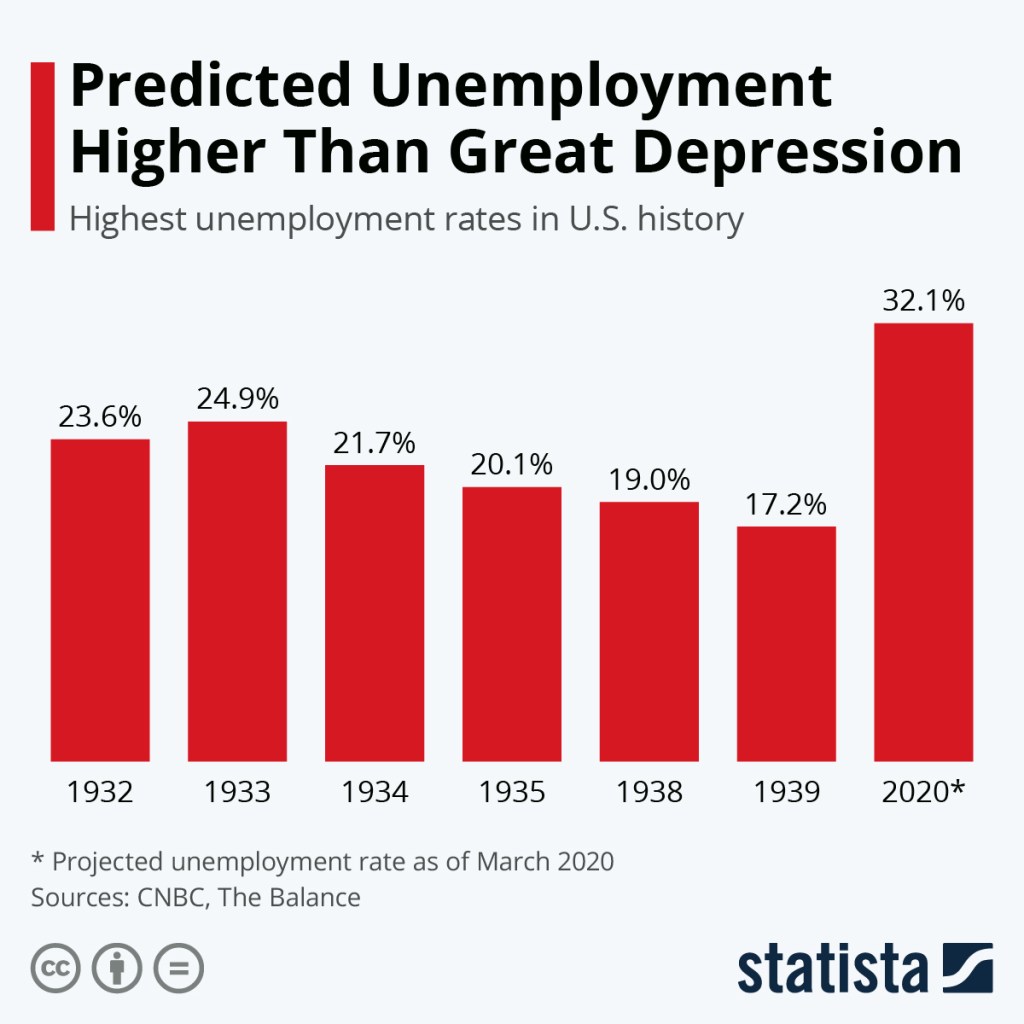
So what is unemployment rate and how does it affect us?
Unemployment Rate is measured as a percentage of people available to work and is seeking for a job but is without a job within the labor force. A high unemployment rate indicates that many families are without income and so their spending power erode. This means that less spending by the individuals when they have little to none income and less spending by the corporations when they have little to none revenue or sales. Imagine a world of people deferring or eliminating their purchasing decision simply because they have none to spend. No more that new iPhone, iPad, Mac, DJI drone, GoPro camera, fancy clothes, hand bags, fancy car, big house, LEGO toy, dinner at the expensive restaurant, overpriced coffee on the way to work everyday, overseas family holiday trips, trip to Disneyland, art & piano classes for the kid, international school education for the kid, and the list goes on. For businesses, deferring investments into that new equipment, new property, expansion plan, employee training, employee benefits, wages, acquisition plan, office upgrading plan, IT plans, machinery upgrade and maintenance plan, etc. etc. All these will have huge implications to the economy and if not fixed quickly, will trigger a chain reaction where more and more businesses will fold and resulting in even more people getting unemployed. A prolonged high unemployement rate will even cause stress in the banking sector when more individuals and companies default in their loan repayment, be it housing loan, hire purchase or corporate loans.
There are people who asked me why do we worry about the U.S. unemployment rate rather than the other parts of the world like those of your own country? The reason is simple. The U.S. is by far the largest economy in the world, being the largest consumer of goods and services produced by the rest of the world. With the largest consumer of goods and services reporting possibly the highest unemployment rate of all time at the quickest rate, do not expect the rest of the world to do well. Demand for goods will fall dramatically resulting in closure of factories in many other countries, causing more layoffs and contributing to higher unemployment rate everywhere else around the globe.
What can we do to minimize unemployment rate? Give free cash for people to spend, lower interest rates and flood the economy with cash and ease of credit. These are some unconventional measures already taken by central banks and governments all over the world. But the question is, how much cash can be handed out to the people? The measures taken can only serve as a cushion to a hard and painful crash. The crash is however, imminent.
So brace for it. It’s coming, whether you are ready for it or not.
 Chua Financial Blog